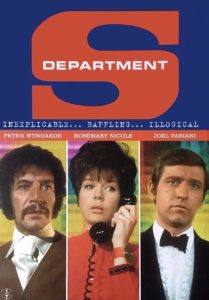
The three investigators from Department S.
When I was a kid in the UK, the TV schedule was full of quirky spy and detective shows. Today, the best known are probably The Saint (starring future James Bond actor Roger Moore) and The Avengers, with dapper gent middle-aged agent John Steed and his barely-legal cat-suited sidekick Emma Peel. But there were quite a few other shows with a similar vibe.
Department S was a British TV series from 1969 about a team of Interpol investigators whose department specializes in mysteries that others are unable to solve. It’s similar to the premise of X-Files, although unlike the problems faced by Mulder and Scully, the Department S puzzles always have a rational solution.
Every episode opened with an impossible situation. For example…
- A businessman gets into his Rolls Royce. When the car arrives at its destination, the chauffeur opens the door to find only a skeleton in the back seat.
- An airliner lands. When the doors are opened, the plane is found to be completely empty.
- A man in a spacesuit staggers through London, then dies from asphyxiation.
Three agents investigate each case, reporting to their boss, Sir Curtis Seretse (a rare example of a wealthy and powerful black character in 1960s TV). The agents are attractive computer expert Annabelle Hurst, American tough-guy investigator Stewart Sullivan, and a novelist, adventurer, and lounge-lizard named Jason King.
It was that last character who got all the attention. King, played by actor Peter Wyngarde, quickly became the star of the show. His face was all over British magazines, competing for space with good-looking singing stars like Engelbert Humperdinck. Yet Wyngarde wasn't a typical pretty boy. He had a long face, a huge head of curly hair, giant sideburns, and a downturned, "Zapata" moustache, drooping eyes, and prominent teeth. He was in his mid-forties, and didn't look young for his age – greying hair and lined, leathery skin. The actor had been appearing on TV for years, often playing villains and sidekicks. Nobody looked twice. But when Department S arrived, Wyngarde was an instant star.
On the face of it, the Jason King character is formulaic. He is a novelist, in the same vein as Ian Fleming. His fictional hero is a tough and sophisticated crime-solver named Mark Caine, and King uses the same mystery-writing skills to solve real-life crimes. He dresses in the height of 1960s fashion, and is irresistible to women. Ho hum. None of this is very original.
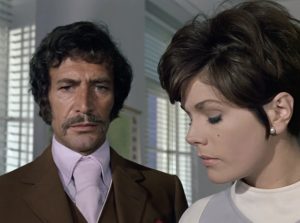
Computer expert Annabelle Hurst and her colleague, International Man of Mystery Jason King.
Yet he is appealing to watch. At first, I found the character a puzzle. King is excellent at applying logic to mysteries, but only so-so when it comes to physical confrontations. He is as likely to lose a fight as to win one. What exactly was the writers' plan here? He wasn't a comically inept Clouseau character, nor was he a tough man of action. What is he meant to be?
But trying to slot the character into a simplistic categories like "tough guy" or "klutz" is the wrong approach. Jason King's personality is extreme, but it clearly works. Thinking about the character from the inside out – his goals and ambitions – he makes more sense. Jason King doesn't just write about his sophisticated fictional hero – he wants to be that hero. He's already got the brains and he can buy the lifestyle, but he isn't actually that tough. Regardless, he throws himself into situations where he faces physical danger – because that's what his paperback hero would do. Sometimes this approach succeeds, but he often fails, and then he feels embarrassed and humiliated. This drive and vulnerability is appealing. The character has a comic aspect, but it also has depth and complexity.
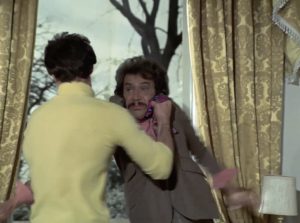
Jason King being thrown around again.
The sophisticated side to his personality is also complex. He's not just a poseur or upper-class snob. King has charm and an acerbic wit. His manner is flamboyant and foppish, almost camp. In hindsight, that shouldn’t be too surprising, because actor Peter Wyngarde was gay, something that was an open secret among actors at the time, but apparently not well known to the public. A gay actor wouldn't usually reveal the fact to the media back in 1969 – even though homosexuality had been legalized in the UK a couple of years earlier, it would still have ruined his career. Today, looking back at the persona of this supposed ladies’ man, it seems glaringly obvious. Like Liberace, Wyngarde was hiding in plain sight.
The character of Jason King was part of the inspiration for Austin Powers – especially the teeth and over-the-top fashion.
(For the, time-travel element of Austin Powers I wonder if that was partly inspired by a a different UK series that aired during the same period – Adam Adamant Lives!, about an Victorian gentleman adventurer who is frozen and emerges as a style icon in the swinging sixties.)
Like the inexplicable thefts in Banacek or the locked-room mysteries of Jonathan Creek, each episode of Department S revolves around an impossible mystery, always presented in the first minutes of the show. I enjoy that sort of setup – it’s something I’ve tried to write myself – and Department S does it quite well. It’s then over to the team, who gather clues, track down villains, and try to sort it all out.
Although Department S was not a big-budget show, series creators Monty Berman and Dennis Spooner made it appear more expensive through heavy use of a library of stock travel footage. A scene might open with an establishing shot of a tropical paradise, then cut to a studio set of a hotel room. It’s quite nicely done, for the time, and does give the scenes some “air.”
The same team used the same technique with their other popular series, The Champions. That seires also featured three operatives, although in that case they all had superhuman powers.
Each episode has a dateline, like "London, England,, May 8th". I suppose the date is intended to add realism, but it always had the opposite effect for me. The glaring lack of a year or weekday draws attention to the fact that it's all made up. If you're going to do it, add the whole date.
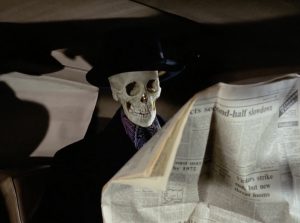
Oh no! A skeleton!
The Department S stories are not always “fair play” mysteries. Although some of the solutions are ingenious and make sense, there are others where the writers obviously sold the episode on the basis of an impossible situation, then struggled to find a good explanation for it.
The skeleton-in-the-Rolls story is one of those force-fit solutions. The skeleton is an arresting visual, and it’s followed by a series of other events where living humans apparently turn into skeletons. Unfortunately, although the episode provides an explanation for how the skeletons appear in the place of living people, it’s never explained why the villains went to such an effort, using such an bizarre, attention-getting method to cover a person’s disappearance, rather than having them leave a goodbye letter. Still, even when an episode’s solution is weak, it’s usually enjoyable to watch Jason King do his thing.
ITC produced the show, hoping to make a US sale, but American networks weren't interested, so Department S didn’t last beyond a single (26-episode) season. Peter Wyngarde’s popularity led to a UK spinoff series, Jason King. That show focuses on the writer, the many women who adore him, and the criminal adventures he’s drawn into. It feels more heavy-handed and self-aware than Department S, and I found it less interesting overall.
It’s easy to find Department S on YouTube and streaming services.